

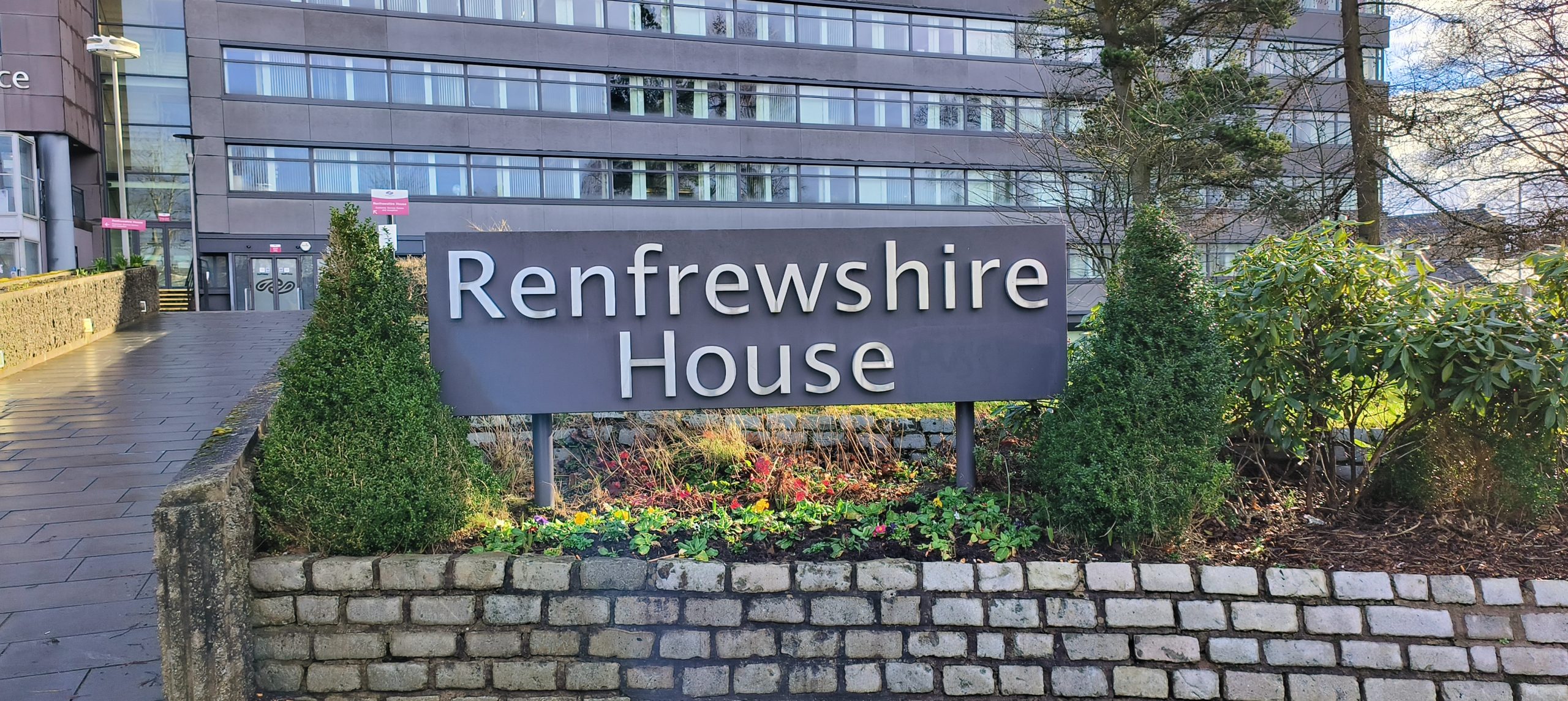
Renfrewshire Council has secured Scottish Government funding for a new project aimed at identifying families at risk of poverty earlier and connecting them to support faster.
The Family Poverty Insight Partnership was outlined to councillors at the Fairer Renfrewshire Sub-committee on Wednesday 25th March.
Annabelle Walter said the project had been backed through the Scottish Government’s Child Poverty Accelerator Fund following a joint bid involving Renfrewshire Council, NHS Greater Glasgow and Clyde and Renfrewshire Health and Social Care Partnership.
The council is leading the work.
She said the funding was designed to test and trial new approaches to tackling child poverty rather than support standard service delivery.
The project will receive around £115,000 over a little more than two years, mainly to cover staffing and analytical work.
Ms Walter told councillors the idea was to build a small-scale local insight partnership that would use existing data from different services to identify families showing early signs of poverty risk.
That would then be used to trigger a more joined-up offer of support.
She said: “The proposal is that we build a small-scale locally governed insight partnership, which essentially means that we are looking for a way that we can use existing data from a number of different sources, initially within the Council, but also looking wider to partners where that’s possible, to proactively identify families that show early indicators of child poverty risk.”
She added: “And then, once we have done that, to connect them quickly to the right mix of support.”
Councillors heard the work would focus on using data already held by services including education, housing, employability, advice and health, rather than collecting new information.
The first part of the project will involve building a dashboard pulling together different data sources to give a more complete view of households.
The second part will look at what support should follow and how it can be coordinated more effectively.
Ms Walter said the project sounded simple in principle but was “really complex” in practice, with major technical, privacy and governance issues still to work through.
Although the project officially starts in April, she said a working dashboard would not be ready immediately.
She said: “It’s unlikely we will have a dashboard up and running in April. That will be us starting to build that process.”
Despite that, she said the project had “huge potential” not only in tackling child poverty but in helping the council better understand which households are using multiple services and which are missing out.
She said the approach could eventually be adapted for other issues beyond poverty too.
An important part of the work will be involving people with lived experience in developing how the system works and how support is offered.
Ms Walter said: “There are a number of risks here around the ethical management of data and around how that feels for households. So we want to work with residents to really understand that and get the feel and the tone of it absolutely right for people.”
Convener Councillor Jacqueline Cameron congratulated officers on securing the funding and said the project could have wider value across the council.
She said: “The data is so important for achieving the outcomes that we want to achieve.”
She added that the work was “beyond data really” because it could help the council understand residents’ needs much better and target help more effectively.