


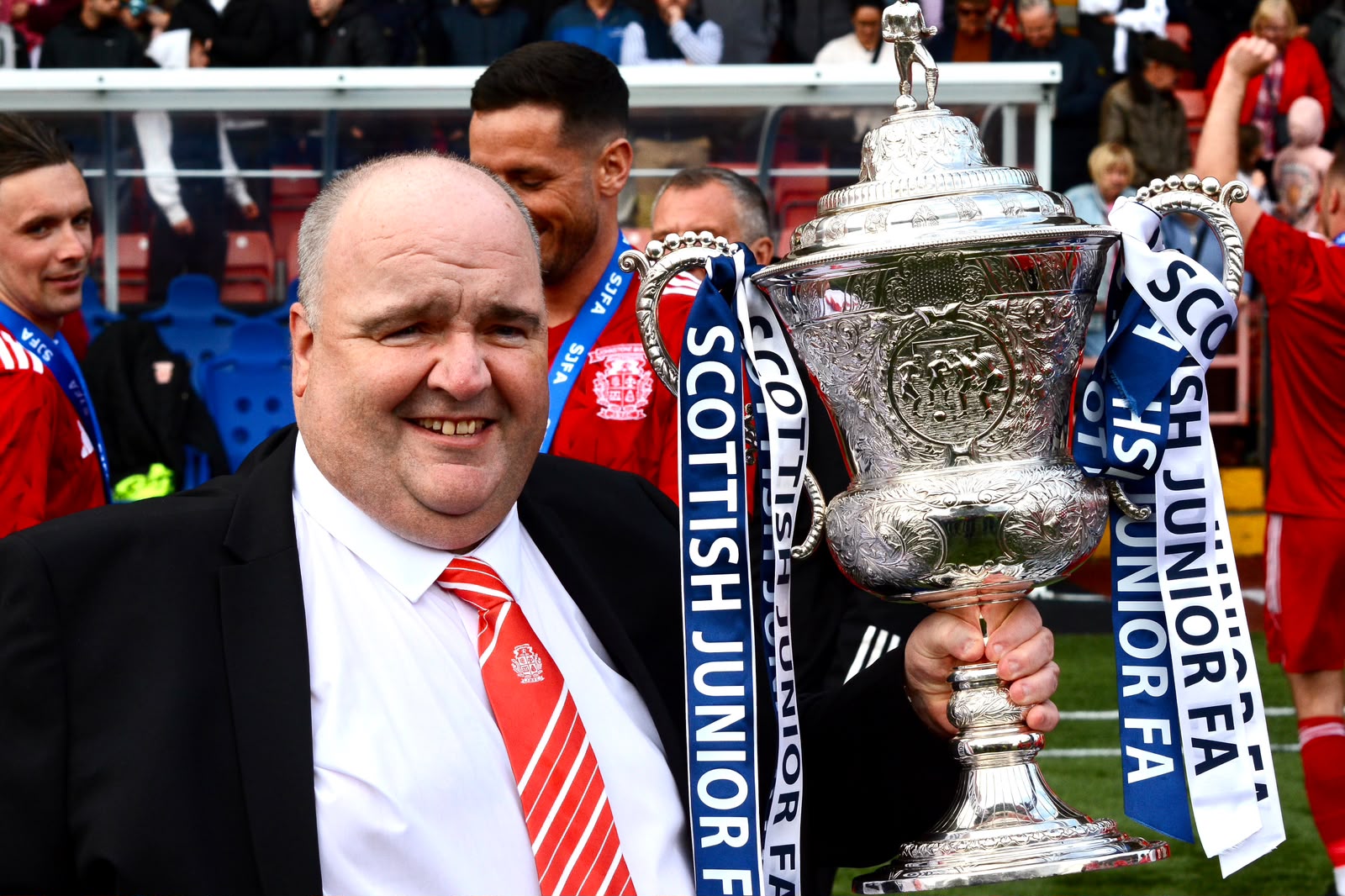
Johnstone Burgh chairman Brian Williams took the Scottish Junior Cup home the night his club won it. He had waited 25 years for another chance to see Burgh lift the trophy. Before he handed it over to the club, he got to spend one night with it.
What stayed with him was the sight of Johnstone turning out to welcome the team home. Earlier in the day, when the team left for the final at Broadwood, there was so much smoke from smoke bombs in the town square that they went round again so they could see the crowds.
“We doubled round again and came back around,” he told Johnstone Sound’s Scoreboard Spotlight during an interview on Monday night.
He said the scenes in the square when they returned with the trophy would stay with him for the rest of his life.
“That was something different, the way the town came out. And obviously the party after it.”
Brian had joined Burgh during the run to the 2000 final, which the club lost. He recalled how rarely they had come close to another final in the years that followed. When they finally won it at Broadwood, he said he burst into tears.
He spent six weeks out of eight selling tickets for the semi-finals and final. Then came another six weeks on the road with the trophy. Players took it into schools, while he and general manager Vic Young visited care homes and businesses. People told him how they had spent the day of the final and, in some cases, how they had managed to make it into work on the Monday.
It was a long way from the Keanie Park he remembered in 2018. The ground was in poor condition and he believed the club had come close to shutting its doors.
He told the show: “Basically, the doors should have been shut. The park was in disarray, basically, and you look at it now, you know, it’s… It’s seriously night and day.”
The chairman credited former manager Jamie McKim with laying the foundations for the rebuild. McKim had been coaching at youth level, and his appointment attracted criticism at the time, he recalled. Burgh had little money to bring in players, so McKim drew on his experience of youth football to bring youngsters into the team.
The club needed experience alongside those youngsters, Williams said. When amateur side Alba Thistle folded, Burgh brought in six or seven of its players. He recalled the team winning 13 of its 14 league games before Covid disrupted the season. Burgh were awarded the league, but he felt the players had missed out on the rewards their performances deserved.
He said the rebuilding of the community club had helped create a more relaxed, family atmosphere at Keanie Park. Under-16s get in free and he hopes the memories they make at the ground will give them a reason to come back as adults.
The clubhouse, which he said used to sit empty between matches, now hosts a range of events, including Tuesday Night Food, a chance for the community to meet and have a free meal that is donated by local eateries. Thursday night is yoga night. There is also a Sunday walking group. On the afternoon of the interview, he had been making vegetable soup for the following night’s meal.
“Obviously the supporters turn up on a Saturday or a Wednesday night, whatever, and that’s fine. They come along and support the club. But the club runs seven days a week.”
He pointed to the work between seasons, when repairs have to be done and the ground made ready for the next campaign. He credited the people around him, including Vic Young and club secretary Jacqueline McLauchlan, who is also secretary of the community club and has been working on funding applications.
Burgh have already put up floodlights and built a stand at Keanie Park. The chairman said the club paid for those improvements itself and has applied for funding to replace the grass pitch with an artificial surface.
“We do have some applications in for funding, to do the pitch, to change it to an Astro next year. So, we’ve got all our fingers crossed on that one.”
He said the club hoped to have more news by the end of the year or the start of next year, with the aim of installing the pitch next season. The redevelopment would happen in phases, with work on the clubhouse potentially another couple of years away.
One of the main reasons for changing the pitch is to give Burgh’s youth teams somewhere to train. An artificial surface would also allow Keanie Park to be used throughout the week and bring in income from bookings.
“But most of the clubs below that, the Astro turf pitch pieces are a revenue stream for them as well, because it means it can get used seven days a week, where unfortunately, a grass part can’t because it won’t take the wear and tear.”
He said there could also be opportunities for walking football and community groups to use the pitch during the day.
He remembered winters when the grass pitch was difficult to play on. Postponements could leave Burgh playing on Mondays, Wednesdays and Saturdays towards the end of the season to get through their fixtures. The surface has improved in recent years, he said, but an artificial pitch could be used more often.
He explained that the community club has youth teams at every age group, and finding somewhere for them to train in Johnstone can be difficult. He sees the new pitch as a way to bring more of those teams to Keanie Park and make space for activities such as walking football during the day. Work on the clubhouse would come later and could still be a couple of years away, he said.
Currently, the age groups play all over Renfrewshire and East Renfrewshire.
Burgh’s win over Formartine United at the weekend set up a Scottish Cup third-round tie away to SPFL Second Division side Dumbarton. Williams said he had barely stopped smiling since the win and was looking forward to the trip. The tie will see Burgh manager Stevie Farrell return to his former side Dumbarton, where he was in charge from 2021 to 2025.
The chairman also spoke about how Burgh could fulfil two cup ties on the same day, away to Tayport and Dunipace. The club has more than 40 registered players, he said, but about half are in the development squad. The under-20s have a cup tie of their own the night before.
He expects the first-team staff to take one game and the development staff to take the other. He and Sean Stewart will split the match secretary duties between the two grounds.
The clash led him to raise a wider concern about the number of cups clubs play in. He said Burgh had been involved in four cups a season in recent years, leaving few Saturdays free for league games in some months. He also argued that the club finishing bottom of the SPFL should be relegated automatically, with its place going to the team that comes through the play-offs from below.
Williams has been involved at Burgh for nearly 27 years, including eight as treasurer and nearly six as chairman. He told the club’s executive committee at the start of the season that he planned to step down at the end of it because of his health.
“At the start of the season I did announce to my executive committee that I do plan to retire at the end of the season. That’s merely purely down to my health.”
He also reflected on the growing demands of running the club, including its finances and technology. He recalled Vic Young introducing card payments within his first two weeks at Burgh, describing it as “a wee bit above my pay grade”.
As Burgh develops, he said he recognised his own limits and was confident in the people taking the club forward.
“I can retire at the end of this season knowing the club is in a good place. There is absolutely some fantastic people at the club and the club’s all facing the right direction.”
Sean Stewart is already training to take over as match secretary. The outgoing chairman said he would be around to help with the handover, including the jobs supporters rarely see, such as dealing with a transfer when the manager calls on a Friday night looking to get a player registered for Saturday.
And when Saturday comes, he still expects to be at Keanie Park.
“I’m leaving as chairman but I say you’ll still find me sitting in the terracing watching the games.”
Photo: Johnstone Burgh chairman Brian Williams with the Scottish Junior Cup after the club’s victory at Broadwood, 25 years after he joined during the run to the 2000 final
Photo Credit: Johnstone Burgh