

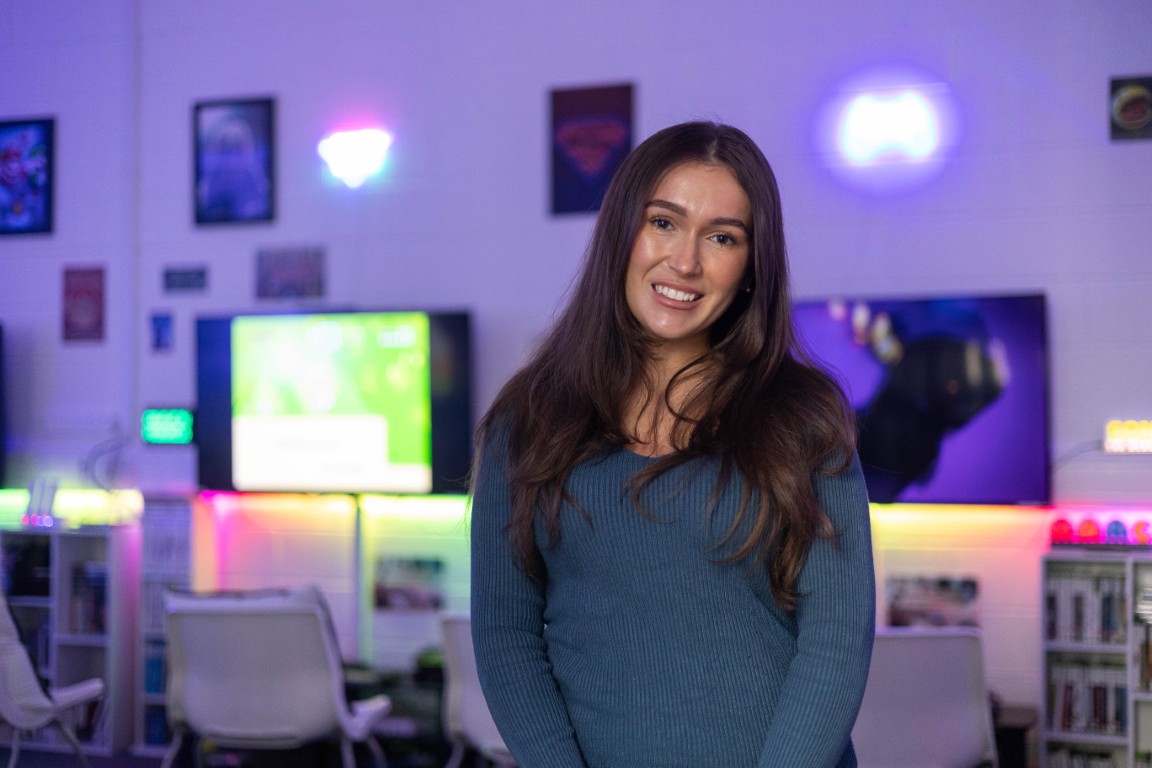
A researcher at University of the West of Scotland has discovered that deaf gamers are creating a new form of sign language to communicate in virtual reality (VR).
The study, led by Paisley PhD student Lara McIntyre, found that some members of the deaf community are developing what is being described as “virtual reality sign language” (VRSL) to overcome the limitations of current VR technology.
The findings have been released to mark National British Sign Language (BSL) Day on Monday 28th April 2026.
British Sign Language (BSL) is a visual-spatial language used by around 87,000 deaf people in the UK, relying on hand shapes, facial expressions, lip patterns and body language. However, the research found that VR headsets struggle to capture many of these elements, particularly facial expressions and subtle movements.
As a result, some deaf users are adapting by simplifying traditional signing into core gestures that can be recognised within VR environments.
Lara said: “VR headsets can’t capture the full spectrum of BSL communication, such as facial expressions, body language and lip patterns.
“Some devices feature audio instruction with no subtitles, while over-reliance on written English can feel foreign to some deaf users due to different vocabulary and grammar structures.
“As a result, VRSL is being used by some deaf gamers – derived from traditional sign language and simplified to core gestures. However, this strips back and dilutes communication, requires new learning and can vary depending on the individual capabilities of different devices.”
VR has become an increasingly popular way for people to socialise, with users interacting through avatars in digital spaces such as virtual cafés and concerts. Around 3.2 million people in the UK are estimated to own a VR headset.
But the study highlights that accessibility barriers risk excluding deaf users from these shared spaces.
According to the Royal National Institute for Deaf People, around 18 million adults in the UK live with some form of hearing loss, including approximately 900,000 who are severely or profoundly deaf.
Lara, who is a CODA (child of deaf adults), said her research is also shaped by personal experience.
She added: “My mum was born profoundly deaf, so her first language is sign language. That can make navigating everyday life – where very few people use your native language – tricky.
“Something that I might take for granted, like bumping into a friend and having an impromptu catch-up, isn’t as easy for her. Social isolation can easily creep in.”
During her studies, Lara has explored ways to make gaming more inclusive, including developing a mobile app to help people learn the BSL alphabet.
She now hopes her PhD research will encourage change across the tech and gaming industries, including the development of VR platforms built around sign language.
Future ideas include sign-to-speech and speech-to-sign translation tools, as well as avatars capable of using sign language in real time.
Lara said: “Part of the solution to making VR technology more inclusive is having a deaf person in the room when it’s being developed.
“There are so many opportunities for VR to embrace, like avatars which use sign language or games which help people learn. Awareness, education and representation can help promote connection and bridge the gap between the deaf and hearing communities.”
Professor Robert MacIntosh, Interim Deputy Vice-Chancellor and Pro-Vice-Chancellor (Research and Innovation) at UWS, added: “The ability to communicate is such an important enabler of participation in every setting.
“Lara’s work shows how languages evolve and adapt in response to new technologies. At UWS, we are proud to see research which has global societal impact and promotes social inclusion.”
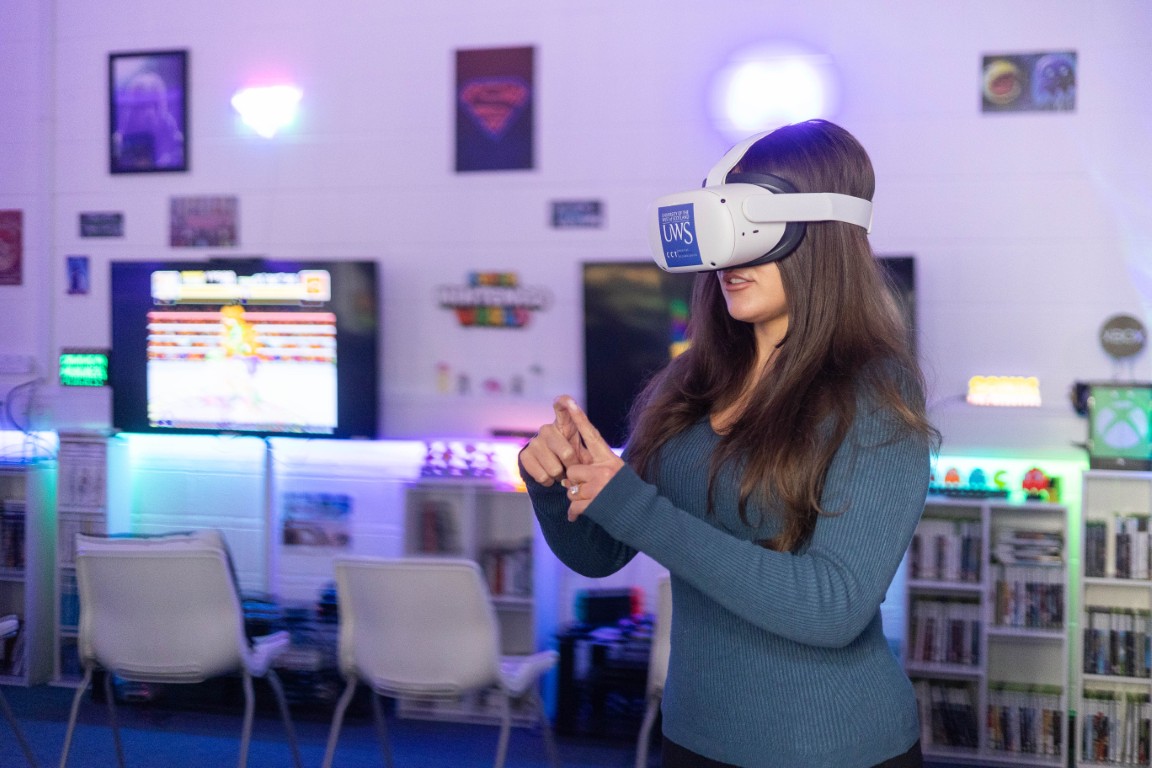
Photo: Lara McIntyre using virtual reality technology as part of her research into sign language accessibility in gaming
Photo Credit: UWS