

Renfrewshire Council is preparing to publish new information aimed at tackling misinformation surrounding migration and asylum after councillors raised concerns about rumours and misleading claims circulating online and within local communities.
The move was revealed during a meeting of the council’s Leadership Board on Wednesday, 17th June, as councillors discussed a report highlighting the impact of migration and resettlement programmes across Renfrewshire.
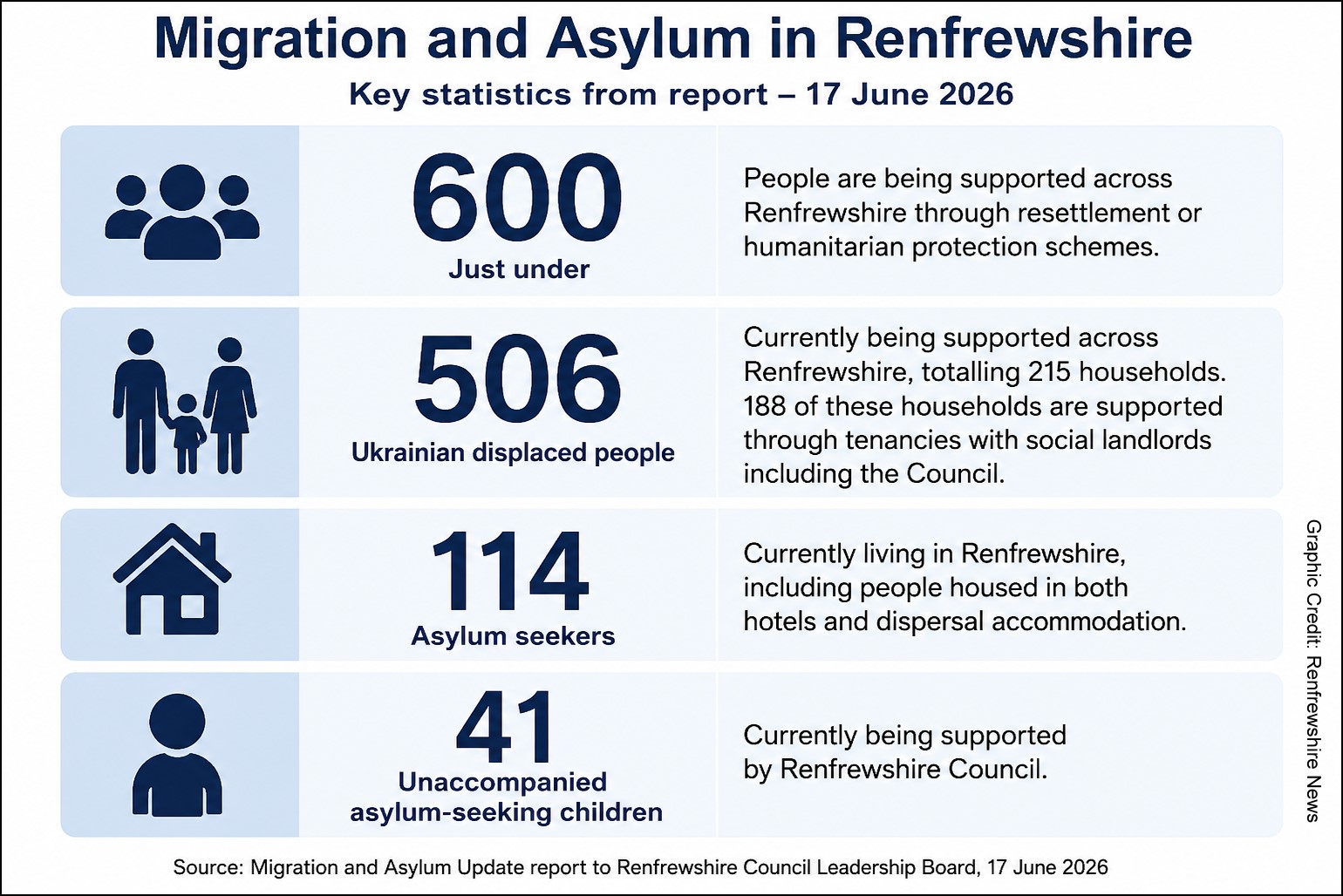
The report showed that just under 600 people are currently being supported through resettlement and humanitarian protection schemes in the area, including families and individuals from Afghanistan, Gaza, Myanmar, Somalia, Syria and Ukraine.
It also revealed that 506 Ukrainian displaced people are currently being supported across Renfrewshire, while there are 114 asylum seekers living in the area and 41 unaccompanied asylum-seeking children being supported by the council.
During the meeting, Councillor Iain McMillan said he had recently been approached by a constituent with questions about housing policies relating to migrants and asylum seekers and asked whether more factual information could be made available to both councillors and the public.
He told the meeting: “We know that there are a lot of rumours and issues around this subject, and we all know that it is a very sensitive subject.”
Councillor Jacqueline Cameron backed the proposal, arguing that providing accurate information was often more effective than engaging in arguments.
She said: “Education and listening to people’s fears and why they have those views is important.
“There is always a scapegoat in such instances, as history has shown.”
Councillor Cameron added that there was often a gap between public perception and reality.
Recalling discussions surrounding asylum seekers housed locally, she said: “The attitude towards that was that they were staying in a four-star hotel, as if they were on the spa and the like.
“I was quite keen to inject factual information into it, but they were only getting £7 a week. It was not enough to cover toothpaste and toiletries and the like.”
Responding to councillors, Renfrewshire Council’s Head of Policy and Partnerships, Laura McIntyre, confirmed that officers have already prepared communications intended to provide residents with clear factual information.
She said: “We have had some comms that have been drafted in partnership with colleagues in the communications team, and they are ready to push the button on.”
Ms McIntyre said officers had delayed publication while waiting for information being developed at a national level through COSLA and other organisations.
However, she added: “There is no perfect time to wait for a final version of that.
“We will make sure that that information is available over the next couple of weeks for members.”
She also invited councillors to suggest additional topics they regularly receive questions about from constituents so they could be included in future updates.
During the discussion, Councillor McMillan also questioned a statement in the report which described the level of change experienced through migration and asylum activity as “considerable”.
Explaining the wording, Ms McIntyre said the council and its partners had spent the past 12 to 18 months examining how population changes were affecting local services.
She said: “Sometimes, people think about migration as being principally about asylum, but we are also looking at the refugee population and people who come here as students to study at local universities and so on.
“We look at that in the round.”
Ms McIntyre said officers had been monitoring the impact on services including housing, schools and employability support, as well as changing demographics and language needs across local communities.
The report was ultimately noted by councillors without objection.